
Why the way people move through a courthouse matters more than you think
Courtroom Design That Balances Security and Circulation
Why the way people move through a courthouse matters more than you think
When the building slows justice
It’s 8:45 a.m.
The courtroom is ready. Jurors are waiting. Attorneys have their notes out. Everyone is doing mental math on how long this is going to take.
And then… nothing happens.
Not because anyone is late. Not because the judge isn’t ready.
An in-custody transfer is underway, and this building has one controlled route to that floor. Deputies clear the path and manage the corridor so movement stays separated. The docket pauses until the transfer is complete.
No one’s in danger. This is standard procedure in a lot of facilities.
But it’s also a reminder that courthouses don’t just host the justice system. They influence how smoothly—or inefficiently—it runs.
These small delays are often the building telling on itself. The way circulation is laid out can either support the day quietly, or make everything work harder than it should.
Courtroom design is more than bricks and benches
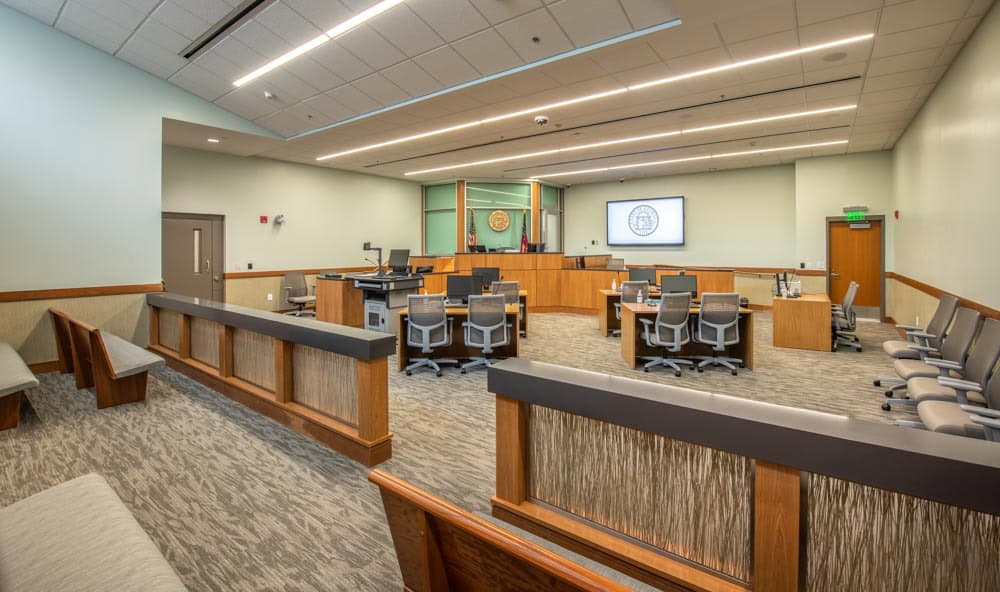
On paper, a courtroom looks simple: a bench, a jury box, a few tables. In real life, it’s a tightly coordinated space with a lot happening at once.
A juror hesitates in the hallway, unsure they’re headed the right way.
A clerk manages records with whatever space is available—because the building ran out years ago.
A member of the public sits down and quietly wonders if they’re supposed to be this close to the proceedings.
Those moments aren’t accidents. They’re design decisions showing up in daily use. Over time, they either reinforce confidence in the process—or add friction to an already stressful experience.
Security starts with circulation
Security in a courthouse isn’t just about screening at the front door. It’s about what happens after people get inside.
In well-functioning courthouses, circulation is clearly defined. Public, staff, jurors, judges, and in-custody individuals move through separate paths. Holding areas connect directly to courtrooms. Secure movement happens out of public view and without unnecessary detours.
When circulation works, most people never think about it. When it doesn’t, everyone feels it—usually in the schedule.
This is where older facilities, phased expansions, and long-term “temporary” solutions tend to struggle. Shared corridors and limited secure routes create bottlenecks that affect both safety and efficiency.
Why this matters day to day
Circulation issues don’t only show up during emergencies. They show up every morning.
They show up when:
- a secure movement pauses an entire docket
- staff spend time redirecting visitors instead of doing their jobs
- jurors arrive stressed before they ever reach the courtroom
- deputies are managing logistics instead of focusing on safety
Good design reduces these moments. It lets the building support operations instead of constantly asking for workarounds.
Common circulation pitfalls
Even well-intentioned courthouse projects can miss here. The most common issues we see include:
- Overlapping paths. Public, staff, jurors, and secure movement sharing the same corridors
- Too few secure routes. Movement has to be staged instead of flowing
- Disconnected holding areas. Longer transfers that slow proceedings
- Form over function. Impressive spaces that don’t work well day to day
None of these are theoretical. They show up quickly once a building is in use.
What good security and circulation look like
Courthouses that operate smoothly tend to share a few basics:
- Clear separation between public, staff, juror, and secure movement
- Direct connections between holding areas and courtrooms
- Predictable circulation patterns that are easy to manage
- Layouts that reduce delays instead of creating them
When these elements are in place, security improves—and so does the overall experience of the building.
Jericho’s approach
At Jericho Design Group, we start by listening. Courthouses don’t all run the same way, and the day-to-day reality matters.
We work with:
- judges focused on efficient transitions and dignity
- clerks managing daily operations and records
- sheriffs responsible for safety and secure movement
- county and municipal leaders balancing budgets, schedules, and long-term responsibility
That perspective allows us to design circulation and security strategies that are practical, defensible, and built to last—without overcomplicating the building or overbuilding the budget.
Security you don’t have to think about
When people imagine court, they picture the courtroom itself. But the experience is shaped just as much by the hallways, elevators, and transitions in between.
A well-designed courthouse doesn’t draw attention to its security. It simply works.
At Jericho Design Group, we design courtroom environments where security and circulation support the process—quietly, efficiently, and with dignity.
